
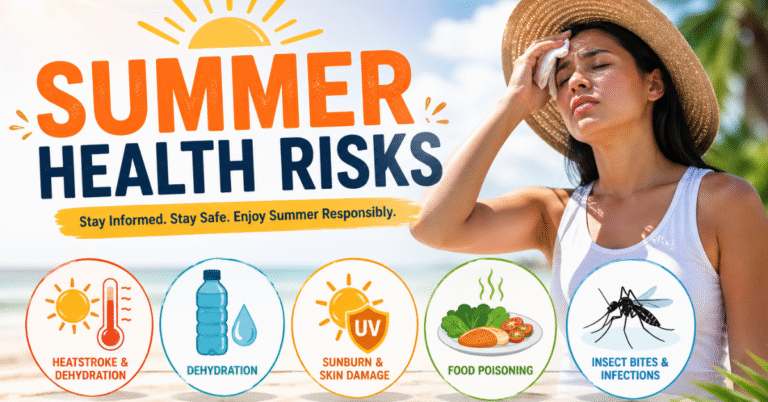


Most people gear up for summer the same way — stock up on sunscreen, drink more water, maybe pull out a fan. And that’s fine. But the health risks that quietly build up during this season? Those don’t usually make the prep list.
That’s a problem.
Summer isn’t just about heat. It’s about dehydration that masks itself as fatigue, viral fevers that sneak up before you’ve had a chance to rest, and mosquito-borne illnesses that get misdiagnosed until they’ve done real damage. None of this is alarmist — it’s just what happens every year, to a lot of people, who waited a day or two too long.
Here’s what’s worth knowing.
Fatigue, dizziness, a vague heaviness — yes, these can be dehydration. They can also be the opening act of a fever. The tricky part is that both feel similar in the early hours, and most people just drink a glass of water and lie down.
That’s not always the wrong call. But it’s a guess.
A quick temperature check takes ten seconds and tells you something real. If your body’s running hot, that’s not dehydration — something else is going on, and you’d want to know sooner rather than later. A reliable digital thermometer does this job well. It doesn’t replace a doctor’s judgment, but it does mean you’re working with actual information instead of hoping for the best.
Seasonal transitions are rough on the immune system. Schools reopen, offices fill up, air conditioning gets cranked — and respiratory viruses move fast in those conditions.
The typical instinct is to wait it out. And often, that’s fine. But “wait and see” works a lot better when you’re actually watching. A fever that stays steady at 99°F for two days is a different situation from one that climbs to 102°F by evening. Without tracking, both just feel like “fever.”
Monitoring temperature a few times a day gives you a trend, not just a snapshot. That trend is often what a doctor asks about first.
This one deserves its own section, because it gets misread constantly.
Dengue symptoms — fever, joint pain, exhaustion, sometimes a rash — look a lot like a bad viral fever. Most people, reasonably, assume that’s what it is. They rest, they hydrate, they wait. And sometimes they’re right. But when they’re wrong, the delay matters.
The platelet count in dengue can drop fast. Early identification means earlier medical attention, which changes how the illness progresses. At-home dengue test kits have made this more accessible — you don’t need to book a lab appointment three days out to find out if you should be worried. You can check, and then decide.
Chikungunya follows a similar pattern. The joint pain can be intense and last for weeks, but early confirmation helps people get appropriate care instead of guessing at a treatment plan.
Here’s the practical issue with summer food-related illness: the symptoms overlap with so many other things. Nausea, vomiting, a low-grade fever — is this food poisoning? A stomach bug? Something else?
The instinct is to wait a few hours and see. That’s often fine. But if a fever is rising alongside the digestive symptoms, that’s a signal that warrants more attention. It could mean the infection is more than surface-level.
Temperature monitoring here isn’t about diagnosis. It’s about deciding whether this is a “rest and fluids” situation or a “call the doctor” situation. That’s a genuinely useful thing to know quickly.
Unlike most summer illnesses, heatstroke doesn’t build gradually with obvious warning signs. It can escalate from discomfort to emergency in a short window, especially in older adults and children.
The early symptoms — headache, confusion, feeling unusually hot — are easy to brush off, especially if you’ve been out in the heat and expect to feel rough. Regular temperature checks during prolonged heat exposure aren’t paranoia; they’re the kind of thing that prevents an ER visit.
If someone’s core temperature is climbing and they’re showing signs of confusion or weakness, that’s not a “lie down and drink water” moment. That’s immediate cooling and medical attention.
Seasonal stress, disrupted routines, heat, and changes in hydration all affect hormonal balance. These things interact in ways that aren’t always obvious, and the gap between “something feels off” and “let me actually check” is often just inconvenience.
Home-based testing kits have made that gap smaller. Whether it’s tracking a cycle irregularity or checking a specific health indicator, having the option to do that privately — without scheduling a clinic visit for something that might be nothing — matters. It lowers the barrier to actually paying attention.
The pattern across all of these risks is the same: symptoms appear, they get written off, and by the time someone seeks real help, the situation is more complicated than it needed to be.
This isn’t a failure of intention. People are busy, symptoms are ambiguous, and most of the time things do resolve on their own. The problem is that “most of the time” isn’t always.
What changes the outcome isn’t heroic medical intervention — it’s having basic information early. A temperature reading. A test result. A trend over 24 hours instead of a single moment of panic. These aren’t replacements for medical care; they’re what makes medical care more effective when it happens.
Beyond the usual sunscreen and antihistamines, a few things are worth having on hand before the season peaks:
A digital thermometer you trust — not the cheap one that gives different readings back to back. Dengue test kits, especially if you live somewhere with standing water or known mosquito activity. And whatever home diagnostic tools are relevant to your household — that looks different for a family with young kids than for someone living alone.
None of this is excessive. It’s just the grown-up version of “be prepared.”
Summer health problems are predictable, which means they’re also manageable. Not every fever becomes dengue. Not every dizzy spell is heatstroke. But knowing which one you’re dealing with, early, makes every outcome better.
That’s not something that starts at a hospital. It starts at home, with the right tools and the habit of actually using them.
Phone: +011-45661377
Email : info@astamdiagno.com, bd@astamdiagno.com
Website: www.astamdiagno.com
Get in touch for business inquiries or orders.
Follow us on social media for updates: Facebook, Instagram, YouTube, Twitter and LinkedIn.