
Healthcare businesses today aren’t just looking for products or so it seems, they’re also hunting for dependable manufacturing partners who can back quality, consistent outputs and that long-term supply rhythm. For big distributors, healthcare startups, and big corporate hospital chains, trying to set up an in-house manufacturing setup usually means a lot of time, heavy investment, and operational resources that are hard to spare.
This is exactly where OEM Contract Manufacturing and Private Label Services can make a real difference in practice. By joining forces with a healthcare manufacturer in India that actually has experience, businesses can spend more energy on their brand, distribution, and customers, while the manufacturing partner handles production and keeps things moving.
OEM manufacturing gives companies a chance to source products based on their required specifications without building their own manufacturing facility. Rather than juggling every production activity in-house, the organization can partner with a specialized manufacturer who understands healthcare product requirements in a more practical way.
For overseas buyers, this approach can also help with supplier diversification. Instead of relying only on one manufacturing geography or a single procurement channel, businesses can treat India as an additional sourcing destination, and keep options open.
And it’s worth saying this clearly: a good OEM relationship isn’t only about “getting a product made.” It is also about grasping specifications, quality expectations, packaging needs, order volumes, timelines, and the real needs of the target market.
For organizations searching for medical manufacturing solutions, this model can therefore become a meaningful piece of their long-term procurement strategy.

Private label manufacturing lets a business sell products under its own brand, while the actual production is done by a manufacturing partner, which is kind of nice because the company doesn’t need to build everything in-house. I mean, it can be especially handy for distributors and healthcare startup teams that would like a more distinct product mix, but don’t want to sink money into their own manufacturing setups right away.
For instance, a distributor might already have a solid customer network in healthcare, but still want to launch items under its own brand. With Private Label Services, the manufacturing process can be tuned to match the buyer’s branding and packaging needs, as long as it fits the relevant product rules and regulatory expectations.
Also, this approach tends to give businesses more room for control in how they show up in the market. Rather than only wrestling over products coming from a bunch of different vendors, a company can craft its own branded set of healthcare items, with a consistent story and positioning. In other words, private labelling can combine manufacturing know-how with brand building opportunities, particularly as healthcare businesses keep growing.
Picking an OEM partner is more than just looking at product pricing. Healthcare buyers should examine the manufacturer’s overall capabilities, their quality methods, documentation standards, production capacity, what level of customization is actually possible, packaging support, minimum order amounts, and the likely lead times.
It’s also important that the buyer spells out the intended market and product requirements up front. Because the needs of a big distributor are not always the same as a healthcare startup, or what a hospital procurement team will expect.
A transparent manufacturing relationship can make future communication much easier, like a smoother back and forth with fewer misunderstandings. Specifications, branding, packaging, order forecasts, and product changes should be talked through clearly so both sides, really, understand what they’re responsible for.
For businesses exploring OEM medical manufacturing, looking at these factors early on can help cut down procurement headaches and build a more dependable supply arrangement.

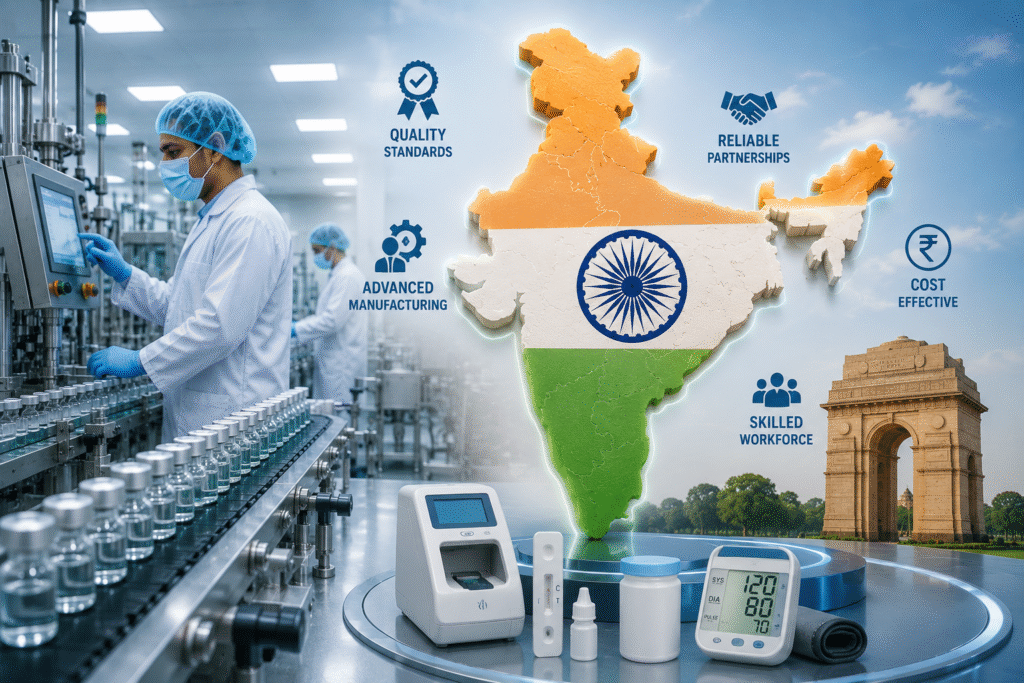
India has grown a wide healthcare and medical manufacturing ecosystem, which makes it a pretty appealing sourcing option for companies trying to diversify their supply chains.
For large distributors, sourcing from India can give them an alternative production base while they also check out competitive manufacturing capabilities. Healthcare startups may also gain from partnering with a manufacturing firm, rather than immediately investing in their own facility.
Corporate hospital groups and bigger healthcare organizations might do something similar when they need steady availability and a structured purchasing process.
The key idea is that the right sourcing decision depends on the product, the market, the technical specifications, the needed volumes, quality expectations, and the commercial requirements. In other words, businesses should screen the manufacturer based on these points, not just pick a supplier because of price.
OEM and private label manufacturing are getting more and more important for healthcare businesses that want to build efficient and flexible procurement strategies. For Big Distributors, Healthcare Startups, and Corporate Hospital Chains, teaming up with a solid Indian manufacturing partner can open doors to supplier diversification, branded product development and long-term growth, not just short wins.
Astam Diagno can be looked at by organizations seeking OEM Contract Manufacturing, Private Label Services, and healthcare manufacturing solutions. You can visit Astam Diagnostics Pvt. Ltd. to get a clearer view of its capabilities and to explore a possible B2B manufacturing partnership.
Q: What is OEM contract manufacturing in healthcare?
A: OEM contract manufacturing is basically a setup where a healthcare company works with a manufacturer to produce products based on agreed specifications, quality requirements, packaging needs, and commercial terms.
Q: What is the difference between OEM and private label manufacturing?
A: OEM manufacturing usually leans toward producing products according to the buyer’s specifications, while private label manufacturing lets a business sell the made items under its own brand name. The real boundaries depend on the contract language between the buyer and manufacturer.
Q: Who should consider private label healthcare products?
A: Healthcare startups, large distributors, medical businesses, and corporate hospital chains may consider private label products when they want to build their own branded lineup, without setting up a full manufacturing facility.
Q: What should I double-check before picking an OEM medical manufacturer, for real though?
A: You should look at their manufacturing chops, quality processes, and how solid their documentation is, also production capacity, the ability to do customization, packaging options, minimum order quantities, lead times, and whether they can actually satisfy the requirements of the market you’re targeting.
Q: Why does India matter so much in medical healthcare procurement?
A: India can work as an extra sourcing and manufacturing base for worldwide healthcare companies. Teaming up with an Indian manufacturer can help organizations look into supplier diversification and shape a more adaptable buying approach, even.
Phone: +011-45661377
Email : info@astamdiagno.com, bd@astamdiagno.com
Website: www.astamdiagno.com
Get in touch for business inquiries or orders.
Follow us on social media for updates: Facebook, Instagram, YouTube, Twitter and LinkedIn.