Big screening programs for infections like Dengue and HIV need more than the quickest test. ELISA and rapid test kits do the work in different ways. ELISA fits well in labs that can run many samples at once. Rapid tests help most when results are needed right away and there is little equipment. The best pick depends on where testing happens, how far along the illness is, and how many samples are waiting.
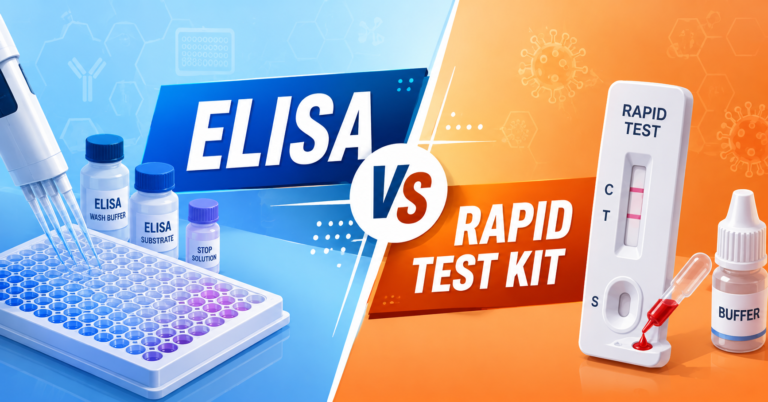
ELISA is an enzyme based test. A person’s sample reacts with the matching antigen or antibody. Then a signal is read by an ELISA device. Using a microplate helps the lab run many samples and include controls in one set. Astam Diagnostics Dengue NS1 ELISA is made for lab use with serum or plasma. It uses a 96 well layout, which supports screening in bulk.
Rapid test kits usually rely on immunochromatography. They can show results by eye, even without a full ELISA setup. Astam’s Dengue IgG/IgM Rapid Test checks IgG and IgM antibodies. Results are typically ready in about 15 to 20 minutes. That speed makes it useful when access and turnaround time matter.
A 96-well ELISA plate can fit many samples in one run. The readout comes from optical density and the lab uses the instrument signal to interpret results.
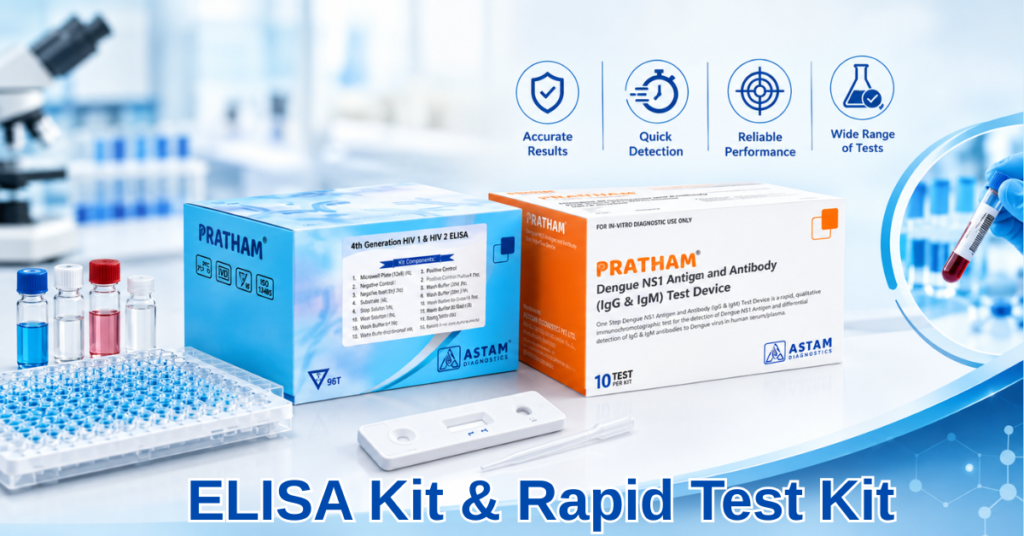
Dengue NS1 ELISA also has value early in infection. NS1 can show up before antibodies do. Astam’s PRATHAM Dengue NS1 Antigen ELISA is made for serum and plasma testing.
For HIV screening, Astam also has PRATHAM 4th Generation HIV 1 & 2 ELISA. It checks both HIV antibodies and p24 antigen, so lab screening can happen earlier.

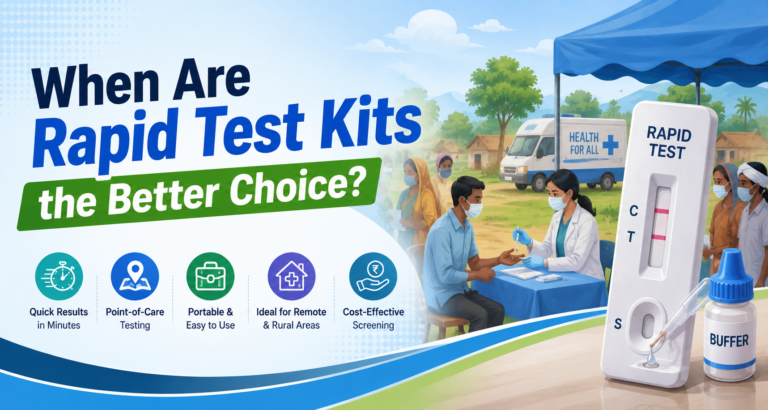
Rapid test kits often fit better in certain situations. When speed, travel needs, and easy access matter more than batch testing, they help. Rural screening camps can face limits. Mobile medical teams may not have an ELISA reader. Primary health centers might lack lab space and tools. During outbreaks, this difference becomes clear.
With rapid kits, clinicians can test near the patient. That supports quicker next steps, like referral or follow-up tests. Astam’s Dengue NS1 Rapid Test gives qualitative NS1 antigen results in roughly 15 to 20 minutes. The Dengue IgG/IgM Rapid Test works with whole blood, serum, and plasma.
For government screening programmes, look at the full cost. Count the total cost per result that can be used and reported. Do not focus only on what one kit costs to buy. ELISA can make sense when a lab already has the needed equipment. It also helps when the lab runs many samples at once. You still have to include infrastructure, trained staff, calibration, and quality checks.
Rapid kits can lower the need for extra lab setup. They may work well for smaller sites and decentralized work. Procurement teams should weigh testing numbers, storage needs, staffing, available tools, and how fast results come back.
For dengue and HIV, there is no single best option. ELISA is usually the better match for central labs that process large volumes. It fits batch work and instrument-based reading when standard workflows are already in place. Rapid tests work well when screening is spread out. They fit outreach efforts and community settings. Results come fast. These places often lack strong lab support.
If an HIV screening result is reactive, it must be handled under the national testing pathway. The usual confirmation steps also need to be followed, as required by local rules.
Buyers should not focus on only sensitivity and specificity. They should also check the intended setting. The specimen type matters too. Storage needs must be reviewed. Quality-control paperwork counts. Shelf life is important. Supply volume and delivery ability matter. Total cost per test also needs attention. Any regulator rules should be checked as well.
Astam Diagnostics makes rapid diagnostic kits and ELISA products. These are made for labs, hospitals, and healthcare providers. The company offers infectious disease rapid tests. It also provides ELISA items for lab use. This covers institutional purchases, business buyers, and government procurement.
The choice between ELISA and a rapid test depends on where testing happens. It also depends on how much sample is used. Turnaround time matters. So does what infrastructure is in place. In centralized labs, hospitals, blood banks, and research units, ELISA options can fit structured workflows. Astam Diagnostics provides ELISA solutions such as Dengue NS1 ELISA and HIV 4th Generation ELISA. For rural camps and decentralized programmes, PRATHAM rapid diagnostic tests can be more workable for screening. With both options, Astam Diagnostics supports organizations that need coverage in lab and field work.
Q: Is ELISA better than a rapid test for Dengue screening?
A: In many cases, ELISA suits centralized work with large sample numbers. Rapid tests can be easier for quick screening in decentralized locations.
Q: When should a Dengue NS1 ELISA be used?
A: You can use it if the lab has the needed setup and if you must detect the NS1 antigen early, during the first days of illness in people with suspected Dengue.
Q: Are rapid HIV tests suitable for large-scale screening?
A: Yes. They fit well for community and outreach work. If a test comes back reactive, the result should be handled under the correct HIV testing algorithm, with the required confirmatory steps.
Q: How quickly does Astam’s Dengue rapid test give results?
A: Astam’s Dengue NS1 and the IgG and IgM rapid tests are meant to give results in about 15 to 20 minutes, based on the product details.
Q: Which is better for rural health camps: ELISA or rapid tests?
A: For rural camps, rapid tests are usually the better choice. They need less lab support and they give results sooner. ELISA is more suited to labs that are centralized.
Phone: +011-45661377
Email : info@astamdiagno.com, bd@astamdiagno.com
Website: www.astamdiagno.com
Get in touch for business inquiries or orders.
Follow us on social media for updates: Facebook, Instagram, YouTube, Twitter and LinkedIn.