
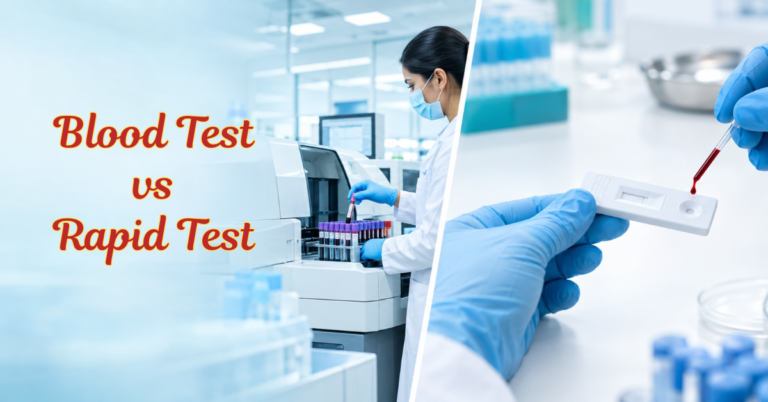

Diagnostic tests are an essential component of modern medicine. They play a significant role in diagnosing, monitoring and informing the decision-making process in clinical care. Diagnostic tests have become essential and widely accessible, with traditional blood laboratory testing and RDTs being two primary methods.
Understanding the differences between these methods helps patients, doctors and laboratories. This guide explains how both of these methods function, their benefits and the trade-offs of using one over the other.
A standard lab test uses blood collected by phlebotomy and analyzes the blood using sophisticated laboratory equipment. Tests can vary by methodology. Some use equipment like auto analyzers or immunoassays.
Other methods are more specialized. Lab tests commonly examine things like blood count, blood sugar, cholesterol, and the state of organ function. They can be qualitative or quantitative and vary by laboratory turnaround time.
A rapid test is a simple test that can be performed with the equipment you already have. They generally rely on immunochromatography, where a test strip has a reagent that binds to an antigen, antibody, or even a hormone and colours when a liquid specimen passes across it.
These rapid tests can even identify specific infections and pathogens like influenza and syphilis.
Though rapid tests are extremely quick to get results, you shouldn’t assume rapid tests are the better option. Every situation is different, and results aren’t always as precise or applicable to your situation.

A blood test describes the type of specimen that is collected, and a rapid diagnostic test (RDT) describes the approach taken to provide the user with the result in a fast manner. Many RDTs also use blood samples.
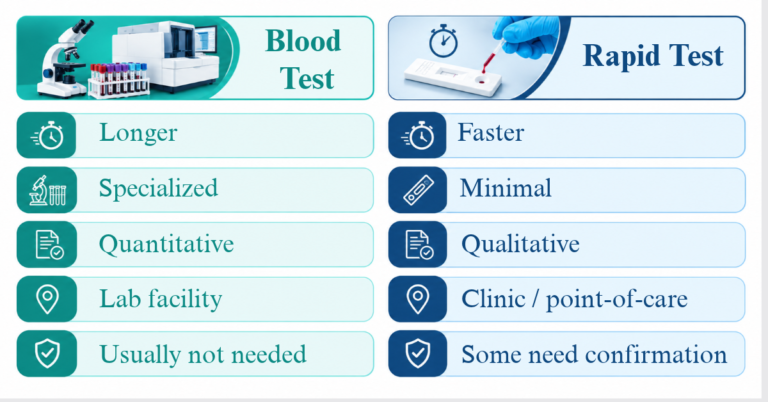
Here are some key differences:
It really depends on the context of the situation and the goal of the test.
When information needs to be acquired in a quick, efficient manner, RDTs are the better option.
Some examples are:
It is very important to always read the instructions that the manufacturer has included with the test. There are instances where negative tests should not be construed to mean that a person is not sick. Some reasons for this can be when a test is done at the wrong time, or a test has certain inherent limitations.
Laboratory tests should be done in situations that need a high level of accuracy and analysis, for example, a quantitative analysis of blood or organ functions.
An example of an additional laboratory test is the follow-up test after a quick reactive test to check symptoms or confirm initial test results.
As with any decision, consideration of the history, symptoms, test sensitivity and specificity, and the applicable clinical guidelines must all take precedence over a focus on speed in selecting the test method.

For each diagnostic product under consideration, multiple important aspects of selection must be considered, not the least of which are the sensitivity and specificity and the intended use of the test. Other equally important considerations include specimen collection, handling, and storage, product quality, regulatory approval, and manufacturer’s instructions.
The final diagnostic selection must always take into account both clinical needs and operational constraints.
Astam Diagnostics Pvt. Ltd. is involved in the manufacturing and supply of rapid diagnostic test kits and ELISA kits. In addition, it caters to the requirements of healthcare service providers, laboratories, distributors, and other institutional buyers.
The company provides OEM and private label services. The company is open for partnership in case you are a laboratory or distributor to explore our range of products and services. You can also view our specifications and inquire about our supply and manufacturing services.
Get further details on Astam Diagnostics official website.
Read further about our Rapid Diagnostic Test Kits.
Laboratory blood tests and rapid diagnostic tests have their unique roles to play in the field of healthcare. As against the laboratory blood tests which are comprehensive and provide information about various metrics, rapid tests which can be performed in the required time frame for a particular case, are useful in situations that are specific.
In such cases, it is the needs of the clinicians and the performance of the test in the validated studies, along with the various recommendations, that help in determining which of the tests would be most appropriate. Understanding this helps the users to perform and interpret the test responsibly.
Phone: +011-45661377
Email : info@astamdiagno.com, bd@astamdiagno.com
Website: www.astamdiagno.com
Get in touch for business inquiries or orders.
Follow us on social media for updates: Facebook, Instagram, YouTube, Twitter and LinkedIn.